Congressman Martin Heinrich: 202-225-6316 / 505-346-6781[1] cool
cool
H.Res 615 is in congress. This resolution states that all members of congress will join any Public Health Care Insurance Plan that they create. We are urging you to call your Congressman and ask him to co-sign this resolution and you want to know if he does or doesn’t. If he does not co-sign you want to know how he votes when it comes to the floor. It is most likely that this resolution will not make it to the floor, but we need to let them know that we know it exists and that we are watching. If a Public Health Care Plan is good for us then it should be good for them.
Congressman Harry Teague: 202-225-2365 / Teague’s offices in the district[1]
Congressman Ben Ray Lujan: 202-225-6190 / Lujan’s offices in the district
NOTES

Uncategorized
-
[ABQ Tea Party] HR 615
Current mood:Calling all Tea Partiers! - It might also be useful to contact their local campaign offices, which I’ve listed below –
- Martin Heinrich: Sean Marcus — 505-231-2422
- Harry Teague: email / Las Cruces — 575.993.5197 / Hobbs — 575.397.2008
- Ben Ray Lujan — P.O. Box 31129 Santa Fe, NM 87594
- It might also be useful to contact their local campaign offices, which I’ve listed below –
-
17 July 2009 ABQ Tea Party
Current mood:
Yesterday morning (Friday, 17 June 2009) I went to the local Tea Party demonstration. Short summary — the petitions were presented to Sen. Udall’s staff, they said that he was going to vote for The Barack‘s “cap and trade” bill and Obamacare regardless of what his constituents tell him. Then the assembled protestors were told to disperse by Albuquerque Police Department for not having a permit.
I arrived in the area at about 9:58 AM, and spent a few minutes looking for parking — that’s par for the course in the Downtown area. If you need to visit that area of Albuquerque between 8 AM and 6 PM between Monday and Friday, be prepared to pay AT LEAST Ø3 for a parking spot — some places can go as high as Ø5 for a spot. After paying Ø4 at the paid lot at 2nd and Central — they have a machine there that prints a ticket for you, instead of the lockbox where you have to fold the bills into a narrow strip and feed them through the slot, now you feed them in, just like a vending machine. Either way, it still takes a couple of minutes, and can be really aggravating if you’re loaded up with personal possessions (laptop, etc.).
After parking, I headed to the group that I had seen on both sides of 2nd St NW, between Tijeras and Copper — pictures below. There were about 20 — 30 people at this location.
Click the pictures to see them as full-size images. 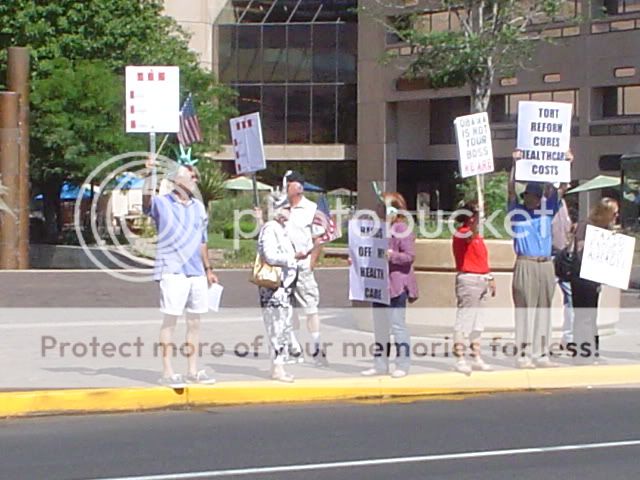


At around 10:20 AM, the protestors moved to the sidewalks of Central Ave, between 2nd and 3rd Streets, outside the local office for Sen. Tom Udall. About 100 people attended this part of the event. An unexpected bonus was that the guy running a local hot-dog vendor was wearing a Tea Party T-shirt from a previous event — he hadn’t known about this event, but was just there selling frankfurters.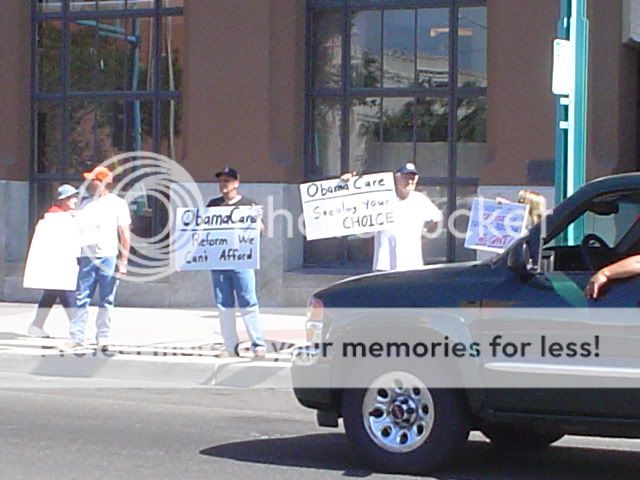

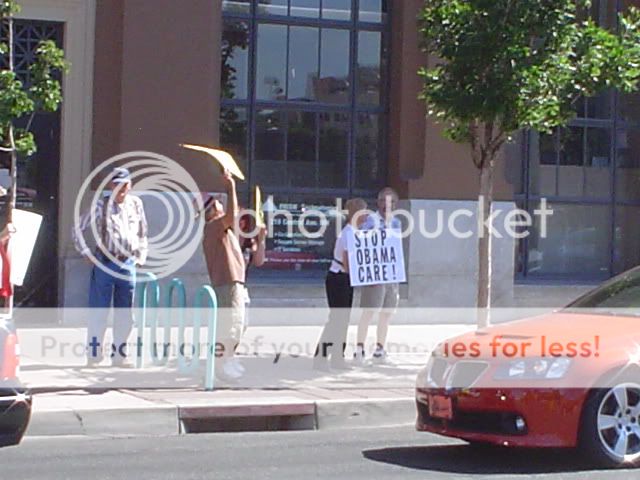
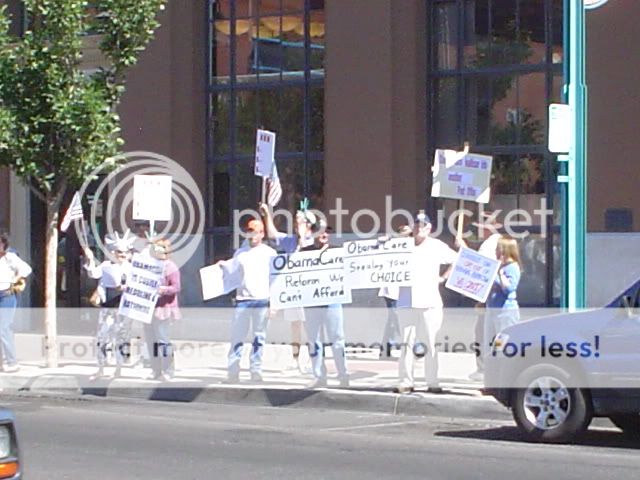
At about 10:30 AM, an APD sergeant (vehicle #J255, NM license plate G-74937) arrived at the scene and started talking to various protestors. As time went on, six other officers arrived. At no time were any of the protestors blocking traffic or any of the building entrances.
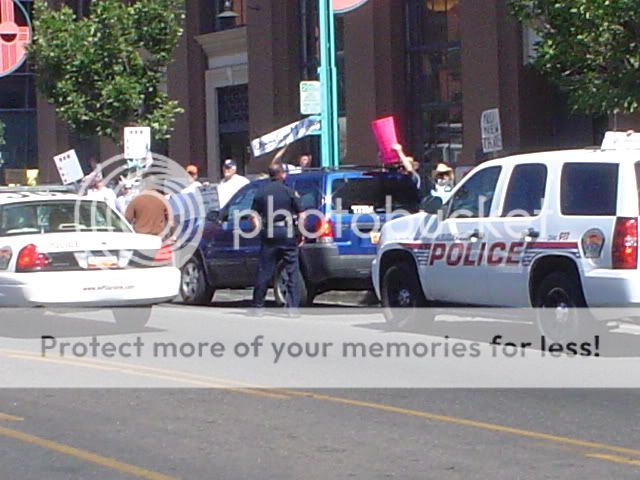

At about 11 AM, the crowd was ordered to disperse, as there were more than ten people and no one had gotten a permit from the City for the demonstration.Lessons learned?
If you’re going to have a demonstration with more than ten (10) people, then it either pays to get the permit OR make sure that everyone understands that they’re all there as individuals, and that the demonstration hasn’t been organized for any specific cause, or any particular group.
The other options are to either just do it and disperse when instructed by police OR make sure that your group is comprised of less than 10 people.
That last option — small-size groups — can work FOR you as well as against you — with small groups spaced every one or two blocks, you can still get the message out over a larger area, thus actually increasing the exposure.
-
Celebrate the 4th of July in Santa Fe

FREE TABLE SPACE!
For directions to the event, go to Google Maps and enter these coordinates into the search bar — 35.659095,-105.97791 — that will take you right to the spot — see HERE.
View Larger Map
Help show America that Independence Day is about more than fireworks, hot dogs and last-minute beer runs.This coming July 4th, celebrate Independence Day and spread the word about your group or company with a FREE vendor spot at a rally in Santa Fe sponsored by one of the biggest political exploratory committees in the nation.
What we’re looking for — organizations offering literature, bumperstickers, flyers, buttons, etc. that support the message put out by the 2008 Ron Paul presidential campaign.
What we’re offering — two 6-foot tables’ worth of space (supply your own tables) for you to advertise your organization or company at least two hours for the public to see your display. We host the event, you show your stuff — AT NO COST TO YOU!
What we’re NOT looking for is material related to the following –
- the “Obama deception”
- “9/11 truth”
- racial nationalism / supremacy (KKK, La Raza, etc.)
- anti-Liberty religion
- conspiracy theories
On that note, we reserve the right to review materials for display, and to reject materials and/or vendors.Contact Mike Blessing at mikewb1971@gmail.com or 505-515-7015 to get on the list.
Tables will be allocated on a space-available, first-come first serve basis. If you don’t show up at the event for your spot, the spot goes to the next one on the list.
-
A Continent-Wide Switzerland?
Reading this week’s edition of The Libertarian Enterprise, I took notice of an resurrected article by long-time friend L. Neil SmithWhat he’s proposing in in his reposted article Radically Decentralized Defense is nothing morethan a continent-wide version of the Swiss Confederation, commonly known as Switzerland.
I don’t say this to disparage his article, but to support it by showing that YES there IS historical precedent on hand for his idea. In fact, I wholeheartedly endorse it, and further note that a significant number of America’s Founders would have supported it, as well.
An addition, though — current (OK, government-sponsored) laser research is expanding to levels you’re only hinting at in this article. At present, they’re working on truck-mountable units capable of shooting down artillery shells and mortar rounds in flight [1]. Where I say “working on,” I don’t mean developing the technology, I mean getting ready for field deployment. Add to that the fact that they’ve already deployed laser units (again, mounted on a truck) for use in destroying IEDs from a distance [2].
NOTES
- en.wikipedia.org/wiki/Tactical_high_energy_laser#Demonstrator
- defense-update.com/products/t/thor-IED.htm
-
Nukes and the Second Amendment
Current mood: annoyed
I’m sure that we’ve all heard it before when discussing the right to own and carry weapons (especially handguns) with hoplophobes and fence-sitters –
C’mon now, let’s be reasonable here — when they wrote the Second Amendment, they weren’t talking about nuclear weapons. Why would anyone want one of those?
FIRST, this argument is a way for the prosepctive hoplophobe to hook you, the ROCW advocate, over to his side. After all, who doesn’t want to be “reasonable,” right?
NOW for the purposes of discussion, let’s assume that my next-door neighbor actually has a fully-functional 20-kiloton fission device in his garage.
SECOND, if he doesn’t set it off, who is harmed? If he does decide to detonate, I won’t even know it if I’m home — the fireball will vaporize the nerves before the signal has time to register in the brain, and I’ll never feel it. And who will the survivors prosecute and/or sue? Certainly not him!
THIRD, I’d like to know who his investment broker is — nukes aren’t something you pick up at the flea market for Ø4.99, or at a gun show, despite Brady Campaign agitprop — they generally run a few million FRNs a pop on the black market, and that’s for the fully-assembled ones. If you can afford to blow that much cash on a one-use item like that, more power to you.
FOURTH, assuming he decided to go the DIY route to building his membership card in the Don’t Fuck With Me Club, it’s true that you can get the general theory and some of the specifics from the internet. Still, assembling the parts will be rather expensive — plutonium or yellowcake isn’t something that you pick up at Home Depot for pocket change — it’s in short supply, as it has peaceful uses in the power-generation field as well as being useful in making nuclear explosives. The deuterium and tritium used in fusion devices is likewise quite rare. Add to this the fact that there’s quite a bit of electronics and chemical explosives needed to make the thing work right, as well. Not only does the prospective protege to Dr. Khan need to acquire this stuff, but he also has to know how to handle the yellowcake or plutonium safely (from what I understand, it’s rather toxic stuff, chemically speaking, in addition to any radioactivity), as well as making the electronics and chemical explosives all WORK TOGETHER PROPERLY — you’ll need at least a bachelor’s degree in physics to make this happen — a masters is more likely. If the chemical explosives aren’t PRECISELY aligned and centered, they might still go off and vaporize the radioactive core, but you won’t get the fireball, flash, shock wave and distinctive mushroom cloud — and that’s what the Suburbian Mad Bomber wants, right?
FIFTH, even with just the “physics package” (the part that goes “BOOM!”), you’re looking at something at least the size of a basketball, if not a beach ball. This isn’t something that you’ll fit in your pocket or on your belt, like a handgun that the hoplophobe is trying to talk you out of carrying and owning.
FINALLY, who says that there are not PEACEFUL uses for nuclear explosives? We’ve had chemical explosives used for over a century for peaceful purposes in these fields –
- mining
- road-building
- tunnel-building
- demolition to remove old buildings, bridges, etc.
In fact, there HAVE been efforts to use nukes for peaceful purposes –
- Project Plowshare was the U.S. Government’s version of a plan to use nukes — see here for the list of proposed uses [1].
- Nuclear Explosions for the National Economy was the Soviet version of Project Plowshare.
- Project Orion [2] was the U.S. Government’s program to develop spacecraft propelled by nuclear explosives — the techincal term was “nuclear pulse detonation.”
NOTES- Micah 4:3 — And he shall judge among the nations, and shall rebuke many people: and they shall beat their swords into plowshares, and their spears into pruning hooks: nation shall not lift up sword against nation, neither shall they learn war any more.
- A FAR BETTER use of the name “Orion” than George Worthless’ attempt to rebuild the Apollo program — “Long live Nixon!” and all that.
- This article was, in part, inspired by an article in The Libertarian Enterprise — Radically Decentralized Defense, by L. Neil Smith
-
More Cash for Winston? (Letter to the Editor)
As submitted to the Albuquerque Journal [Thursday, 28 May 2009 3:39 PM] –
More Cash for Winston?
Tuesday (26 May 2009), APS Superintendent Winston Brooks held a press conference where he admitted that APS was sitting on an extra $16 million, and had been sitting on that pile of cash for ten years [1].
Of course, in the near future, Winston and the School Board will ask us, the voters, to approve more school bonds on behalf of APS. Perhaps they’ll even trot out the old saw that “this won’t raise your taxes.”
So I pose the question to you, fellow Albuquerque voters — are YOU willing to give Winston and the Board more of YOUR hard-earned cash, so they can waste it or forget they have it? How many more child molesters can APS hire with that cash of yours?
NOTES
-
Removing military weapons from civilian hands (Original version)
Current mood: accomplished
I’ve been looking for this version of the following document for a while — there’s a few lines of text that have been changed from it in subsequent versions, such as the one I posted previously. This one is as close to the original that I discovered and reposted back in 2000, complete with the occasional errors in the HTML coding (look for the fractions at certain points of the text).
I found this little gem of an article at the Federation of American Scientists’ site — http://www.fas.org/asmp/campaigns/smallarms/discus-1.htm. For what it’s worth, don’t look to the FAS to defend the right to keep and bear arms, either.
My previous comments stand today just as much today as during the Bush Administration when I first posted this little gem of hoplophobia to various gun-related message boards and Yahoo! lists. If not moreso, considering The Barack‘s desires for more and more victim disarmament — there’s HR 45 and his stated desire to renew the 1994 “assault weapon” ban, as well as his plan to sign and ratify and the CIFTA Treaty. Add to that Jackboot Janet II (Napolitano [1])’s reports about “right-wing extremists” and Rahm Emanuel’s suggestion to bar anyone on the “no-fly” list from owning firearms.
Here’s the line from the first version I found that went missing from following versions —
Such weapons distort societies, they make it increasingly difficult for a society to rebuild itself following a period of bloody conflict, they make it harder for the State to regain the legitimate monopoly of force, they enhance the capabilities of criminals, thus compromising the effectiveness of police forces and encouraging law-abiding civilians to arm themselves for protection, they lower the threshold for violence and they are very easy for children to obtain and use.
[Emphasis mine -- see here for where that line pops up in the actual text.]And that’s what it’s alll about for a lot of these folks — gaining (or regaining) and retaining that “legitimate monopoly of force.” Think about that phrase — “monopoly” means the following –
- A situation, by legal privilege or other agreement, in which solely one party (company, cartel etc.) exclusively provides a particular product or service, dominating that market and generally exerting powerful control over it.
- An exclusive control over the trade or production of a commodity or service through exclusive possession.
- The privilege granting the exlusive right to exert such control
Meaning, if you aren’t in the club that’s been granted that monopoly, you’ll have limited access at best to the commodity in question.
Since the “commodity” I’m talking about here is the use of physical force for self-defense, well, that physical force is what they want a monopoly over.
Does it matter to them if you need an AK-47 to protect your family from roving bandits, as many do in sub-Saharan Africa? Not in the slightest, and all in the name of “protecting” you from those same criminals.
Why does it not concern them if you are killed by criminals, so long as you remain unarmed?
How else are they going to use you for their purposes as a lab rat or production unit? If you’re armed, you might pose a threat when they show up at your front door, ready to put you to work, seize your assets, or enroll you in their latest social-engineering scheme.
Removing military weapons from civilian hands A draft discussion paper circulated for comment Christophe Carle and Patricia Lewis
UNIDIR Geneva August 2000
We look forward to receiving your comments (plewis@unog.ch and ccarle@unog.ch).
Over the recent months, a momentum has begun to build around the idea of focusing a world-wide campaign against the prime types of weapons that are killing and maiming people in conflict and post-conflict regions.This embryonic campaign, now a collaboration between governments, NGOs and IGOs, is exciting because it stems more from the humanitarian action and health communities than it does from the disarmament sector. The focus of the campaign is on what is needed rather than what is thought to be politically possible.
We have written this discussion paper in order to assist and the growing debate on military-style weapons. There is a strong urgency associated with this process. While we dither people are dying and being in injured in large numbers. Societies are being destroyed and futures are being ruined. We realise that a serious campaign could well use the 2001 small arms conference as its springboard and urge that action is taken before then to ensure maximum support for this process.
This draft paper is intended for researchers and policy-formers working in the fields of conflict prevention resolution, humanitarian aid, refugee aid, emergency health, disaster prevention, development, post-conflict building, arms control and so on. We hope that it will stimulate discussion and we would like feedback before 31 October 2000. Please feel free to circulate this paper on an informal basis, but please do not cite it in its draft form or quote from it as it now stands. We think it likely that the paper will be extensively modified before it is published and we look forward to receiving your comments (plewis@unog.ch and ccarle @unog.ch).
The problemOf all of the small arms that are killing and maiming people throughout the world, military and military-style automatic weapons are as terrible as landmines in their devastating effects. Like landmines, their destructive power far outlasts the conflicts they were originally designed to fight.
These weapons are made for war. They have been designed to be used by trained military personnel. However they have spread well beyond their intended clientele, into the hands of the illicit arms traders. Their abundance and firepower can exacerbate violent conflict, prolong the fighting, increase the participation of civilians and make conflict resolution even more difficult.
This is a humanitarian issue of the first order. Bringing to bear a humanitarian/human rights focus on the small arms efforts in the international arena ¾ and thus concentrating on the spread, use and individual solutions to the problem of military style weapons in civilian hands ¾ may succeed in removing one of the most deadly threats to people in the world today.
The legacy of military style weapons is seen on the streets of countries in Africa, Latin America, South Asia, Central Asia, Europe, the Middle East and South East Asia where they can prolong conflicts, and propagate the interests of organized and opportunistic criminals. In other regions, such as North America, Western Europe or Oceania, their widespread availability has landed them onto the streets of cities to serve the purposes of organized crime and the drug barons. In some cases they have found their way into the hands of unstable individuals with tragic consequences. They have played a central role in destabilising civil law and order where its grip is often tenuous.
They are used in small and large-scale conflicts throughout the world. They include arms such as Kalashnikovs, G-3s, M-16s and FN FALs. What makes them so dangerous is that they are highly destructive, with a rapid rate of fire, powerful, easy to use, inexpensive and in abundance. For example, it is estimated that more than 70 million assault rifles have been produced since World War II and used in well over 90 countries
Their ease of use and widespread availability makes it more likely that civilians will be drawn into war-fighting. This is particularly true for young people because these weapons require very little skill and training to use and their small size means that they can be carried and used even by children.
Following a conflict, a number of paths lie open to the spread of civilian-held military-style weapons:
- They can be sold and transferred on to other conflict regions;
- They can be kept by the civilians and used for protection in the absence of state controlled law and order;
- They can be sold to the criminal fraternity in the region;
- Their possession and use can make ex-combatants into criminals;
- They can be collected and destroyed (along with constraints placed on importing other weapons into the region).
Such weapons distort societies, they make it increasingly difficult for a society to rebuild itself following a period of bloody conflict, they make it harder for the State to regain the legitimate monopoly of force, they enhance the capabilities of criminals, thus compromising the effectiveness of police forces and encouraging law-abiding civilians to arm themselves for protection, they lower the threshold for violence and they are very easy for children to obtain and use.
Military-style weapons are a threat to people in war-ravaged societies. When they remain in the hands of ex-combatants following a conflict they continue to keep the violence-threshold low and increase the likelihood of a return to full-scale violence, thus perpetuating conflicts.
Not only do these weapons find their way into conflict zones and into the hands of civilian combatants, but they also turn up in weak or failed states, in states with permissive legislation (where they can be legally-held) or poorly-enforced legislation and in states with paramilitary forces, terrorist groups and uncontrolled reserve militia.
The presence of military-style weapons in the hands of civilians not only has an impact in terms of the direct humanitarian effects (deaths, terrible injuries, long-term disabilities and so on) but this situation can severely undermine the delivery of humanitarian assistance in conflict zones and in refugee camps by compromising the security of personnel who are working in vital humanitarian assistance.
They are transferred through both licit and illicit means, through brokers, through the illegal sale of legal military equipment by the armed forces, police and corrupt officials. Once in the illegal market they can be bought at very low prices or they are stolen ¾ such crimes going unreported. Primarily, they are bought or stolen because of a perceived need – a need to fight or protect, a need to gain status, provide food and security, a need to dominate in the face of scarce resources.
Solutions
This is such a complex and widespread problem that there is no one solution or approach. There have to be regional, subregional, national, unilateral, multilateral, bilateral, global approaches working in tandem in the hope of making some dent in the problem.
It has to be acknowledged at the outset that none of these approaches can be fool-proof or leak-proof. Most solutions to these problems can only be significant in the long run, and success will vary according to context, but fewer people will die, fewer people will be maimed and, where conflict-prevention fails, societies will more easily rebuild themselves after violent conflicts.
1. Banning sales to non-State actors?
One solution would be to have national, international and regional agreements or codes-of-conduct on selling military weapons to regular armed forces only.
The big problem with this idea is that there are sometimes strong reasons for non-state actors to require such weapons in order, for example, to overthrow an illegitimate, cruel and corrupt government when non-violent means have been exhausted etc. In addition, there are many concerns as to who would impose such bans and who would monitor them.
There are arguments, however, that such concerns are over-emphasised. Certainly, with a handful of significant exceptions, violent overthrows of corrupt regimes often end up with equally corrupt and inhumane successor regimes. Non-violent pressure is often far more successful in achieving the long-term progress of a country than armed struggle. In addition, the atrocities committed by paramilitaries, particularly those that have recruited children as combatants, have been so horrific that curbs on sales of military weapons to non-state actors may have to be considered as one of the approaches to be taken, with some provision for an exemption clause depending on agreement within the international community.
2. Breaking the chain
Destroying surplus weapons and stockpile management
Dealing with surplus weapons has two main aspects. The first is for governments to destroy weapons deemed obsolete or in excess to national needs, rather than sell them. This may not always be easy, particularly in countries in which governments themselves do not keep precise accounts of their own inventories or in countries where sales or surplus weapons are used to fund purchase of new weapons. Some countries may also lack the means for effective and environmentally friendly means of destroying surplus weapons and their associated ammunition. Both inventories and destruction techniques and equipment may sometimes require the provision of specialised assistance from states and companies (often the major arms manufacturers themselves) with more experience in these matters. This applies particularly to ammunition. However, for the weapons themselves, simple destruction by crushing and burning by local factories and foundries may well suffice. Indeed, experience shows that the political process of obtaining agreement to begin a weapons-collection programme and the organization of the programme itself is the most difficult part. However, a weapons collection programme that doesn’t include a destruction phase, is vulnerable to becoming a focal point for the illicit redistribution of the weapons once collected.
The only way of ensuring that military small arms do not fall into the wrong hands is to make sure that they are securely held and accounted for by legitimate state authorities, and better still, that they are destroyed if and when the state no longer requires them. International or regional standards and regulations could be developed to assist in proper stockpile management. South Africa’s initiative to destroy its redundant stockpile of weapons, and the assistance provided by Norway to that end, are recent experiences from which lessons and inspiration should be derived in other national and regional settings.
The second aspect is more difficult. It would involve the mopping up of automatic weapons currently in the hands of civilians, as a prelude to their destruction. Cash for weapons is an option that raises well-known problems. Weapons for goods and services, in particular “weapons for development” seem more promising. Such an approach requires the collective approval of a community, individuals are not rewarded ¾ rather the village or region obtains something for the collective good. Those handing in the weapons are then seen as contributing to the community, whereas before they may have been seen as people bringing terror and crime into the area. This option presupposes an accurate identification of genuine and practical development needs in order to offer useful and attractive incentives for civilians to hand in their weapons and that these needs will contribute to genuinely permanent solutions. Above all, it also presupposes the ability of the State to provide adequate protection for civilians and for the development projects themselves.
National, regional and international attempts to increase transparency and to develop transnational systems for tracing military style weapons transfers, along with legal measures to prohibit civilian possession could be developed. Multilateral, bilateral and unilateral measures could all work in parallel on the different regional levels, depending on the requirements of the varying situations.
3. Brokering
Brokers trading in weapons, as they would in any other commodities, commonly act as legal and illegal purveyors of small arms to regions, countries and factions in conflict. Customers desperate for weapons can be expected to pay a premium for arms provided in this way. Such brokering is unregulated and difficult to trace because most countries lack legislation covering such activities by their own nationals, and because fake documentation (especially end-user certificates) is easily obtained from corruptible officials. Transactions typically involve several countries as transit points both for the weapons and for funds, without the weapons transiting through the country from which the broker operates.
Adequate national legislation should require the registration and licensing of brokers, whether operating from their own country or from abroad. This will require international cooperation and information exchange. They should be held responsible for any unlicensed activity, or for contravening export-control laws and international embargoes. Such strictures should apply equally to brokering in weapons and in ammunition. The development of an international agreement to increase transparency and to regulate the activities of arms brokers, agents and transport companies, could be seriously considered – ¾ including the concerns over the use of brokers by governments in order to cover-up illegal sales.
4. Ammunition control
The 7.62 or 5.56 calibre ammunition for military-style automatic rifles is widely produced and traded. In conflict situations, it is used in large quantities. Regulating its supply from both domestic and foreign suppliers could therefore assist in reducing the incidence of violence and the duration and destructiveness of conflicts. Where weapons are widespread and offer no immediate hope for successful mopping up, and where combatants require resupplies in ammunition, restricting ammunition supplies can be the only significant option. Reducing the ease with which ammunition can be acquired can also make it less attractive for former combatants and civilians to retain their weapons in post-conflict situations. As with the weapons themselves, legal governmental stockpiles of ammunition need to be properly managed and accounted for so as to increase the legitimate control of stocks. Ammunition stocks need to be regularly monitored and surplus and obsolete along with unusable and unstable stocks need to be destroyed rather then sold off.
5. Civil society campaign
One of the great difficulties with the debates around controlling small arms and light weapons is the large numbers of legal, about-to-become-illegal and illegal weapons in circulation and the complexities involved that are raised by increased availability ¾ not least of which is the often understandable need for such weapons in a number of situations. This has made it easy for opponents of small arms control in any form to knock down initiatives and ideas as quickly as they spring up. It has also meant that it has been hard to find a collective focus for a civil society-based campaign on the issue, with NGOs working on a myriad of scattered initiatives, and often seeming to be running around in circles.
In addition, it has proved extraordinarily difficult to gather reliable data on the types and quantities of small arms that are in existence and that are doing the damage.
However, both from quantitative research and strong anecdotal evidence, there is clearly a major problem with military weapons in the hands of civilians as outlined above.
If a concerted campaign were to be formed to remove such weapons from civilian hands this would have a number of distinct advantages:
- It would strike to the heart of the humanitarian problem — their removal and control would have a significant impact on the numbers of killing and maiming during and post conflicts;
- It would provide a clear focus and sense of purpose for NGOs and governments alike;
- It would be hard for the anti-control lobby to argue against such an initiative — after all who could easily justify the right for civilians to bear arms built for military purposes and thus argue taking automatic and semi-automatic weapons off the streets of cities and out of schools;
- The public is likely to readily understand and support such a campaign in both developed and developing countries;
- It might be easier to gain cross-country support and assist like-minded (and interested parties) initiatives;
- It might be easier to implement both nationally and sub-regionally with support at the international level than attempts to control a much wider cross-section of weapons.
- International cooperation both at the regional and global level will be required
- Civil society organizations could develop an education and awareness campaign for preventing the spread of military style weapons and for the collection and destruction of those in circulation.
Conclusion
The time seems to be ripe for a different approach to small arms control. This approach should be focused on the weapons that are doing most harm to people and their security. Efforts in small arms control, such as marking, tracking, ammunition control, production control could all form part of this approach, but only as part of a bigger whole, driven by humanitarian needs. Such efforts then would no longer be perceived as tinkering at the edges of the problem, rather their efficacy could be determined in the light of the larger goal. Tackling civilian-held, military-style weapons may provide an approach that could strike to the heart of the problem, obtain global and regional support, provide a focus for governmental and non-governmental action and achieve lasting good.
www.unog.ch/unidir/
Last updated: 21 September 2000
NOTES- Janet Reno was the first, considering that she was on board with the 19 April 1993 FBI / Delta assault and massacre at Waco, Texas — all in the name of “protecting the children.” Good job her people did, “protecting” those 27 kids by choking them with CS gas, then machinegunning them behind the building (where the press was blocked from viewing) as they tried to escape.
-
Strategy and Tactics
Strategy and Tactics
by L. Neil Smith [ lneil@netzero.com ]
Attribute to The Libertarian EnterpriseEach morning I find a dozen messages in my e-mail concerning evil plots by the current administration or some other enemy of individual liberty to take away our guns, our money, our homes, our children, our cars, our land, our gardens, our right to speak out, or travel freely, or whatever else it is that momentarily tickles their kleptocratic fancy.
Their kleptocratic and murderous fancy.
Seldom does this litany of grievances conclude with any suggestion about stopping collectivist predation, or punishing the predators. The focus is always on what “They” did to us in the past, on what “They” are doing to us now, or on what “They” are planning to do to us in the future.
There are at least a couple of reasons for this. One of them is a pathological and pathetic desire on the part of some individuals for victimization, a value they pervertedly tend to treasure — and defend — more than any amount of freedom, prosperity, progress, or peace that actually rising up and doing something about it might win for them. They display an energetic resentment (I know, because I’ve often been on the receiving end of it) toward anybody who dares to offer them genuine solutions to the troubles they luxuriate in complaining about.
Also, they might actually have to unplug their thumbs and do some work. The academic equivalent is to keep generating scholarly papers that nobody reads, until the Romans come and cut you down as they did Archimedes.
Misplaced reliance on electoral politics is another reason all you ever hear from certain quarters is petulant whining. You can almost define conservatives (who still have a long way to go to reestablish themselves as members in good standing of the general freedom movement) as those who would rather squat in their own dung, piteously ululating over their cruel circumstances, as long as they can lay everything, every two or four years, in the unclean hands of crooked jackasses in cheap suits and cheaper ties who never quite manage a total commitment to the concept of self-ownership and the Bill of Rights.
They (petulant, squatting conservatives, not crooked jackasses, who know better) calculate that if they vote faithfully and contribute to campaigns and right wing causes, they’ve done all they can —- all that can be done —- about the totalitarian cesspool we’ve all slid into.
Various anarchoid colleagues to the contrary, there is a place for political action in an overall libertarian strategy, but this isn’t it.
A related problem is an ill-advised reliance on institutions like the National Rifle Association, who must learn —- or be taught somehow (despite a demonstrated inability to benefit from experience) —- that they are not up to bargaining with left wing socialism, unfit to wheel and deal with proven enemies of freedom. They are out of their depth because they misunderstand the basic nature of the conflict they find themselves in, and because they, themselves, are socialists of the right wing variety. Early drug war enthusiasts, in spite of repeated libertarian warnings, they helped erect the vicious anticonstitutional federal establishment now threatening to destroy them and the rest of us.
I’ll never forget how thrilled (and surprised) I was when NRA Executive VP and CEO Wayne “Pepe” LaPierre referred to federal law enforcement officers as “jackbooted thugs” (now abbreviated “JBTs”) or how disgusted (and unsurprised) I was when he pusillanimously took it back.
The national Libertarian Party is in even worse shape at the moment.
So what can be done?
First of all, forget all about both the traditional political spectrum —- which only offered people different reasons to sacrifice themselves to one voracious power-hungry collective or another -— as well as those described later, even by yours truly. There was no genuine freedom advocacy until libertarianism came along in the late 1940s and early 1950s. The past decade of state security terrorism has made it plain: there are indeed two political sides in this country, not right versus left (they’re on the same side) but freedom versus non-freedom.
Period.
Don’t worry about the mythical past, grieve over imagined former glories, or waste precious resources trying to regain liberty we never really had. The Roman republicans made that mistake and never got what they wanted. Concentrate instead, on a future in which we have built everything we desire with our own hands and minds. That’s what I’ve written about for the past 30 years and it’s time more people paid attention.
For the time being, forget abortion and immigration, too. You’re never going to change my mind about them, and they’re the issues the anti-freedom side counts on to keep the pro-freedom side divided. There will be plenty of time to argue about them later, in the warm, mellow light of liberty —- or behind the barbed wire of the FEMA camps.
Most of all —- and if you take nothing else away from this essay, take this —- we can no longer afford to fight every issue the enemies of freedom present us with. Libertarians must learn to promote those solutions that undercut several —- or all —- statist assaults on our liberties at the same time. If we fight them one picayune battle at a time, we will always lose —- in fact, it’s why we have always lost so far.
That’s why I invented the concept —- and the phrase —- “Bill of Rights enforcement” years ago. It covers every different bit of victim disarmament legislation the enemy throws at us, while supporting free speech, freedom of assembly, and other liberties, at the same time, as well. It underlines an important and neglected truth, which is that freedom is indivisible, that in fact there is really only one freedom, the freedom to be left unmolested, by the state or anybody else. Fight in the name of Bill of Rights enforcement and you will gain allies whom you wouldn’t have had before, possibly solving many problems at once.
I’ve also offered ideas, over the years, any one of which, pursued with energy and persistence, could have changed —- could still change —- our miserable situation. Most lately, it’s been the National Recall Coordinating Committees and an effort to repeal Article 1, Section 6 which grants to legislators immunity from prosecution or lawsuit for their acts of criminal predation. If I were a leftist, I’d have a tenured university position by now, and my own ten million dollar think-tank.
It didn’t have to turn out this way, of course.
Seeing clearly what was about to happen to us, in the 70s and 80s, I wrote to the editors of various gun magazines who might have raised and organized effective opposition to all the subsequent violations of the unalienable individual, civil, Constitutional, and human right of every man, woman, and responsible child to obtain, own, and carry, openly or concealed, any weapon —- rifle, shotgun, handgun, machinegun, anything —- any time, any place, without asking anyone’s permission.
If they’d fought then, we wouldn’t have to fight now. But instead, advertising being more important than freedom, they patted me on the head —- one even called me “hysterical” —- and basically told me, “Go away, boy, you bother me”. I haven’t bought a gun magazine since Brady Bill-Bob Dole pushed the Clinton gun and magazine bans through. I don’t know why I haven’t given up the same way on the libertarian movement.
I’ve made mistakes in my life, and have plenty of things I regret, but the worst is my failure to communicate —- to those who claim to stand for freedom — that none of the measures I’ve proposed actually have to pass into law in order to have the effect we desire them to have.
The other side, you must understand, is just as fearful, just as hysterical, just as inclined to stampede purposelessly all over the landscape, to bargain and compromise stupidly, to waste time, energy, and money, and get screwed by their own politicians, when they hear of organized political efforts that would threaten them. They huddle together, whimper to each other, and dirty themselves, exactly like conservatives.
How do I know this? Partly because I worked with the left in the peace movement and the Eugene McCarthy campaign in the 1960s. Partly because I watch and listen to them now. Conservatives keep asking why the left —- which now controls the House, the Senate, and the White House —- is still angry and unsatisfied. It’s because they know that in democratic politics, nothing is ever really settled, and they’re afraid.
How do we use this knowledge?
Allow me to propose yet another project. Let’s call this one the “Obama Akhenatenization Act”. The idea is simple, based on the efforts of their royal successors to eradicate every trace of the religiously radical Pharaoh Akhenaten and his consort Nefertiti. On January 20, 2013, a new law will go into effect, under which each and every decision, decree, edict, guideline, mandate, measure, notice, order, ordinance, precept, regulation, requirement, ruling, promulgation, and statute enacted during the Obama presidency will be declared null and void.
Now, for a short, self-indulgent moment, just imagine all of the screaming, moaning, whimpering, and handwringing that this idea will generate among left wing socialists, if it gets enough exposure in the media and on the Internet. Imagine the panic, hysteria, wasted motion, and squandered resources. Imagine all the moderates, gradualists, and compromisers who infest the left wing cluck-clucking at their fellow collectivists that they’ve gone too far, they need to backpedal, back off, soften their tone, and slow down. How do I know that this will happen? Because I’ve been fighting the moderates, gradualists, and compromisers who infest the freedom movement what seems like all my life.
The “Obama Akhenatenization Act”.
And when they whine at us about it, we’ll tell them that our next goal is to repeal every law and abolish every agency created since 1913.
Tactically, an undertaking like this offers tremendous advantages over any mere exercise in electoral politics. In the first place, you don’t have to wait two, four, or six years to start the ball and keep it rolling. Anyone can work to publicize and promote the Obama Akhenatenization Act 24 hours a day, seven days a week, 52 weeks every year.
We don’ need no stinkin’ election.
Even better, every individual involved can speak equally for the Obama Akhenatenization Act and what it means. We don’t have to settle for, prop up, and constantly find ourselves apologizing for some fatuous moron of a candidate who either doesn’t really get it, or is deathly afraid of being embarrassed by the public appearance that he does.
It doesn’t really have to be the Obama Akhenatenization Act, of course. It can be anything, any authentically pro-freedom measure. The more outrageous the better. Every time you talk about it, you win a victory for liberty. You make some socialist’s stomach churn, you cost him a night’s sleep, you shorten his actuarial life-expectancy by five minutes —- exactly as they’ve been doing to us for three or four generations.
And while the opposition is busy chasing down his Tums and Pepcid with Maalox and Pepto-Bismol, you can explain to your onlookers what’s actually at stake. With freedom you can do anything; without it, you can do nothing. Anybody who would diminish freedom for any reason —- whether it’s saving the planet, preserving national security, or “for the children” —- is an enemy of his fellow human beings, not their benefactor.
And certainly not their savior.
The “Obama Akhenatenization Act”.
So how about it? Are you willing to give up your victimhood, roll up your sleeves, and get your hands dirty helping create a culture of freedom?
Or would you just rather whimper until the JBTs smash your door down?
Four-time Prometheus Award-winner L. Neil Smith has been called one of the world’s foremost authorities on the ethics of self-defense. He is the author of more than 25 books, including The American Zone, Forge of the Elders, Pallas, The Probability Broach, Hope (with Aaron Zelman), and his collected articles and speeches, Lever Action, all of which may be purchased through his website “The Webley Page”.Ceres, an exciting sequel to Neil’s 1993 Ngu family novel Pallas is currently running as a free weekly serial at www.bigheadpress.com/lneilsmith/?page_id=53
Neil is presently at work on Ares, the middle volume of the epic Ngu Family Cycle, and on What Libertarians Believe with his daughter, Rylla.
See stunning full-color graphic-novelizations of The Probability Broach and Roswell, Texas which feature the art of Scott Bieser at BigHeadPress.com. Dead-tree versions may be had through the publisher, or at Amazon.com where you will also find Phoenix Pick editions of some of Neil’s earlier novels.
-
MARINE! TAKE THAT HILL!
Current mood:
I’ve been seeing more and more of Adam Kokesh on the web, and I like what I see from him more and more.
For those who don’t know, Adam is considering a run for U.S. Congress in New Mexico’s Third District, against the incumbent, Ben Ray Lujan.
Will the GOPNM get behind Adam for his run? I can’t really say for sure — the Republican Party of New Mexico has definitely supported its share of big-government candidates — Heather Wilson and Pete Domenici come to mind there. The GOPNM has supported its share of losers in the 3rd District, as well –
- F. Gregg Bemis Jr. got an “F” rating from GOA in the 1994 race, while Bill Richardson got a “C.”
- Dan East ran in 2008 as a typical Bushevik neo-con, supporting the Iraq Occupation and waffling on the Second Amendment.
As for his opponent, Ben Ray Lujan, well . . . Ben Ray is the poster boy for New Mexico’s patron system, where it helps A LOT to know someone who’s politically connected, and it helps EVEN MORE if you can grease the right palms (cash ØØØØ only, please!) — especially if you’re seeking government-sector employment or contracts. After all, his old man, Ben Lujan Sr., IS the Speaker of New Mexico’s State House of Representatives. The scuttlebutt in some circles seems to be that Ben Ray wouldn’t have received the Democratic nomination for the Third District if his daddy wasn’t the Speaker.
And I can’t resist posting this image of a campaign T-shirt — it’s PURE GENIUS!

It doesn’t hurt at all that Ron Paul weighed in on his sideAnd don’t forget to visit his Money bomb site!

Recent Comments